Historia 🇫🇮🇬🇧
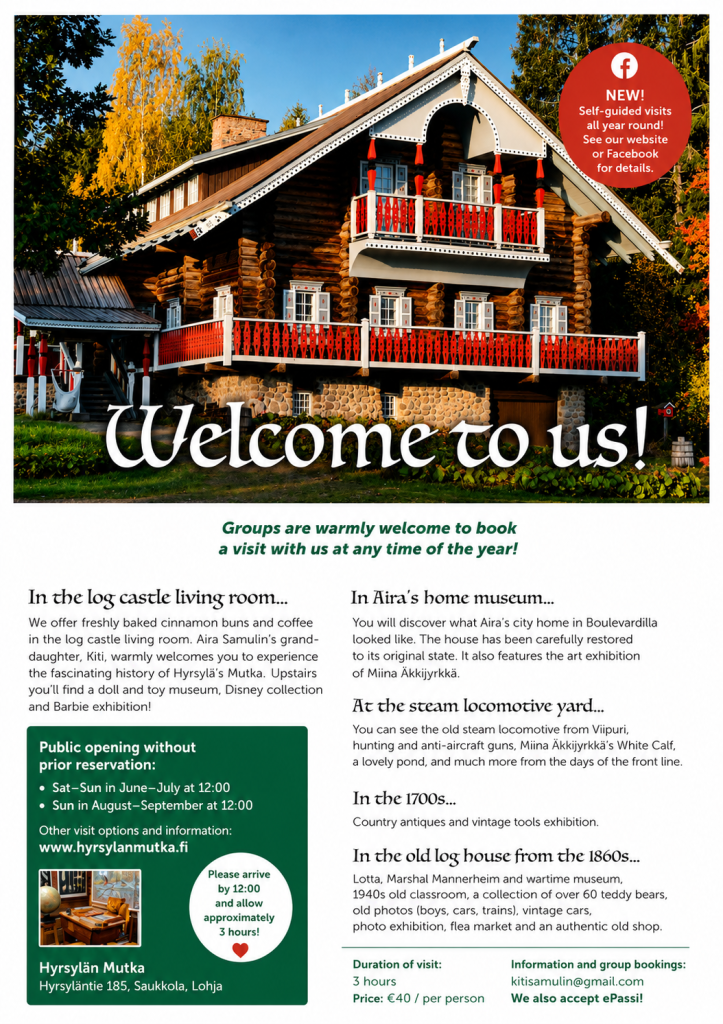
Vuonna 1983 valmistunut Aira Samulinin luoma Hyrsylän Mutka on matkailukohteiden helmi ja museokokonaisuus vailla vertaa.
Yli 30 muistorikasta museota ja elähdyttävää näyttelyä on jaettu viiteen eri rakennukseen.

Aira Samulin syntyi Ignoilan kylässä, Hyrsylän mutkassa itärajan tuntumassa 1927. Siellä oli säilynyt yli 200 vuotta vanha kulttuuri savupirtteineen ja itkijänaisineen. Upea kansa, joka eli luonnon kanssa symbioosissa ja kylätiellä vaihdeltiin kuulumisia jopa poisnukkuneiden kanssa.
Vain muutama vuosi ennen Airan syntymää sinne rakennettiin tie ja rajavartiolaitos, jonka vuoksi Airan isä, rajajääkäri-vääpeli Viktor Suvio siirrettiin vartiopäälliköksi suojelemaan Suomen rajaa mukanaan Airan äiti Anna-Liisa. Ilman tätä siirtoa Aira olisi syntynyt Viipurissa kuten kaikki muutkin sukulaiset.

Viipuri oli Suomen kansainvälisin kaupunki teattereineen ja hienohelmoineen, jossa Airan perhe kävi useasti sukuloimassa. Hyrsylän mutkassa taas piti iltaisin kulkea kaverin ja lyhdyn kanssa susien ja karhujen varalta. Tämä kahden maailman yhdistelmä loi vankan pohjan Airan ytimeen. Vaikka Aira rakasti Hyrsylän mutkaa, odotti hän kovasti pääsevänsä Viipuriin oppikouluun.
Unelmat kuitenkin murskautuivat kun sota syttyi 1939. Sotilaat perheineen oli tässä vaiheessa siirretty sisämaahan. Hyrsylän mutkaan jäi ainoastaan naiset, lapset ja vanhukset. Venäjä julisti sodan 30. marraskuuta klo 12.00 päivällä. Edeltävänä yönä klo 03.00 oli Hyrsylän mutka jo vallattu ilman varoitusta. Kaikki jäivät sotavangeiksi. Toista tuhatta siviiliä. Tulipalopakkasissa heitä kuljetettiin vankileireille ja kuljetuksien aikana he kärsivät vammauttavista paleltumisista ja 52 alle vuoden ikäistä vauvaa paleltui kuoliaaksi. Pienet ruumiit heitettiin susille hankeen. Vankileireillä siviilejä ehti kuolla toista sataa. Vain muutamassa kuukaudessa. Ei heitä tapettu, mutta annettiin kuolla. Aira oli kauhuissaan. Hän oli varma että kaikki naapurit, kaverit, opettajat kaikki kuolevat. Onneksi rauha solmittiin ja vangit vaihdettiin. Kukaan ei tosin osannut aavistaa että pahempaa olisi vielä luvassa.
Yli 3 vuotta kestävä jatkosota tuhosi kaupungit ja perheet. Jätti vaimot sotaleskiksi, tappoi isät ja pojat. Myös Airan isä kaatui jatkosodan alussa. 14-vuotias Aira sekä Äiti Anna-Liisa löysivät hänet kaatuneena rintamalta Nuijamaalta. Tämän jälkeen ei ollut enää mitään syytä jäädä rajan tuntumaan. Perhe lähti Helsinkiin etsimään Viipurilaisia sukulaisia ja järjestämään hautajaisia. He saapuivat suoraan pommituksiin. Ilmahälytyksiä oli harva se päivä ja pulaa oli ihan kaikesta. Nälkää nähtiin joka ikinen päivä.

Vuonna 1982 Aira sai kuulla että Länsi-Uudellamaalla on Hyrsylä-niminen kylä ja hänen päässään räjähti. Sinne hän haluaa rakentaa muistomerkin näille Hyrsylän mutkan sotavangeille. Koko elämänsä ajan Airaa oli kalvanut ajatus että hän pääsi kuin koira veräjästä kun sotilasperheet siirrettiin pois Hyrsylän mutkasta ja kaikki muut jäivät sotavangeiksi. Ei heistä eikä heidän kokemuksistaan koskaan puhuttu mitään, eikä saanut puhua. Vihollinen uhkasi tappaa jos puhuu. Aira mietti pitkään mikä olisi sopiva kunnianosoitus tälle kansalle. Kuka nyt keskelle metsää tulisi mitään patsasta katsomaan. Hän otti selvää ja vanhan kansakoulun entinen laidunmaa olisi kaupan. Sen saisi pilkkahintaan jos alueelle rakentaisi talviasuttavan rakennuksen. Aira tuumasi ettei hän millään pienellä mökillä mitään tekisi että rakennetaan sitten kerralla niin suuri talo että hän voi kutsua kaikki sotavangit kylään talon valmistuttua. Talo rakennetaan heille!
Aira otti yhteyttä rakennusneuvos Pekka Taviin ja kertoi löytäneensä Hyrsylä-nimisen kylän ja haluaisi rakennuttaa sinne Hyrsylän Mutka-nimisen talon. Pekka vastasi että: ”Kuule Aira. Miulle tarjottiin juuri 400 siemenpuunrunkoa. Mie ostin ne näkemättä kun niitä niin harvoin on tarjolla. Sie saat ne!”
Siitä se lähti! Yhdessä legendaarisen arkkitehti Vilho Suonmaan, koristepuuseppä Reijo Kivilahden sekä Pekka Tavin kanssa Aira suunnitteli Hyrsylän Mutkan mieleisekseen kunnioittaen 1000 vuotta vanhaa rakennuskulttuuria joka on periytynyt isältä pojalle. Missään ei säästetty. Kaikki tehtiin käsityönä. Hirret löytyivät valtion metsästä läheltä Nurmesta joten oli viisasta myös rakentaa Hyrsylän Mutka siellä. Jo rakennusvaiheessa ihmisiä alkoi kiinnostaa kenelle näin suuri karjalaistalo on menossa. Talon ympärille piti rakentaa aita että kirvesmiehet saivat tehtyä työnsä rauhassa. Talo rakennettiin, hirret numeroitiin ja purettiin. Lastattiin rekkoihin ja matka kohti silloista Nummi-Pusulaa sai alkaa. Kun lehdistö sai kuulla että talon tuleva omistaja on Aira Samulin he kirjoittivat kissankokoisin kirjaimin että: ”Onko Aira Samulin tullut suuruuden hulluksi, kun rakentaa itselleen tällaisen kesämökin?”

Nykyisellä paikalla oli vasta kaivettu kuoppaa ja tehty valut, kun ihmisiä rupesi käymään rakennusmaalla. Aira ajatteli, että kylläpä tämä nyt kiinnostaa ihmisiä ja oli kovin mielissään.
Taloa rakennettiin läpi kesän. Syksyksi saatiin vesikatto ja talveksi lämmöt päälle. Aira järjesti ensin tapahtumia tunnetuille ystävilleen ja kutsui lehdistön paikalle. Lehdet kirjotti ja kansaa kiinnosti. Aira ajatteli, että mitäpä jos hän alkaisi vastaanottamaan ryhmiä. Maaliskuussa 1983 saapui ensimmäinen ryhmä. Aira oli jo hankkinut antiikkipöytiä, tuoleja ja muutaman arabian kannun. Hän tarjosi pullakahvit ja kertoi tarinansa. Vieraat olivat niin tyytyväisiä että sana kiersi ja ryhmiä rupesi käymään. Aira sijoitti kaikki vierailta tulleet rahat Hyrsylän Mutkaan. Hän keräsi antiikkia, vanhaa arabiaa ja vanhoja käsitöitä. Vihdoin Hirsilinnan sisätilat olivat valmiit ja hän kutsui kaikki Hyrsylän Mutkan elossa olevat sotavangit kylään. Nöyrä kansa ei voinut uskoa silmiään että heidän takiaan tällainen oli rakennettu.

Ryhmien vastaanotto jatkui ja Aira mietti mitä muuta vierailijat haluaisivat kenties nähdä ja mieleen tulivat vanhat nuket, nallet ja lelut sekä talonpoikaisantiikki. Aira kiersi kirpputoreja, antiikkimarkkinoita, huutokauppoja ja hankki valtavan kokoelman joka kasvoi niin että tarvittiin jo lisätilaa näyttelyille. Hirsilinnan alakertaan tehtiin tilaa lelu-ja nukkemuseolle.
Pohjois-Karjalasta löytyivät 1700-luvun vanhat aitat. Toisessa on naisten käsityönäyttely pannumyssyineen ja ristipistotöineen ja toisessa miesten käsityönäyttely voikirnuineen ja ämmänlänkineen. Aittojen seinustoja koristavat lukuisat talonpoikaisantiikit.
Kokoelmien kasvaessa Hirsilinnan alakerta pyhitettiin nukeille. Noin 500 nukkea, parisataa Barbieta ja saman verran Disney-hahmoja. Tarvittiin lisää tilaa nalleille ja leluille. Aira oli kuullut että naapurin vanhaa hirsitaloa purettiin polttopuiksi uudemman talon tieltä. Kun Aira näki kuinka kaunista hirttä lautojen takaa paljastui hän ei voinut antaa näin tapahtua. Aira lunasti 160 vuotta vanhan hirsitalon polttopuiden hinnalla. Taas hirret numeroitiin, purettiin ja siirrettiin Hyrsylän Mutkan tontille. Tämä upea 1860-luvulla rakennettu, miltei 500 neliöinen hirsitalo sai nimekseen Wanha.
Wanhalta löytyi tilaa noin parille sadalle antiikkinallelle sekä poikien leluille junineen, peltiautoineen ja puuhevosineen. Siellä on myös sota- Marski- ja Lottamuseo, 40-luvun vanha koululuokka, 60 vanhaa opetustaulua, vanhat valokuvat-näyttely sekä Airan elämäntyöjulistenäyttely. Yläkerrassa on suuri kirpputori.
Alueella on siis rakennuksia neljältä vuosisadalta. 1700-luvun aitat, 1800-luvun Wanha hirsitalo, 1900-luvun Hirsilinna sekä 2000-luvun esteetön hoivakoti joka rakennettiin yhdessä Remontti-Reiskan kanssa ja siitä tuli moniosainen sarja televisiosta. Hoivakoti on rakennettu sillä ajatuksella että mitä pitäisi ottaa huomioon jos haluaisi asua omassa kodissa mahdollisimman pitkään. Mielellään loppuun saakka. Talossa ei ole rappusia eikä kynnyksiä. On leveät oviaukot ja invavessa. Pistorasiat ovat keskellä seinää eikä alimmassa nurkassa. Jopa valojen väritila on mielelle hyvä. Koska taloa markkinoitiin ”Airan vanhuuden kotina” niin tietysti talossa on tanssisali jossa joustava lattia sekä lämmin uima-allas jossa voi vesitanssia. Talo toimii nykyään Airan kotimuseona jonne vieraat pääsevät tutustumaan. Museo on kopio hänen entisestä kaupunkikodistaan Helsingin Bulevardilla ja esillä on Miina Äkkijyrkän upea taidenäyttely.

Pihamaalta löytyy Miina Äkkijyrkän Valkoinen Vasikka, höyryveturi, panssaritorjuntatykki, hevospatsas talvisodan rintamavarustein, Airan isän, Viktor Suvion graniittinen näköispatsas sekä isän veljen, olympiakultamitalisti, nyrkkeilijä Sten Suvion muistopatsas, kesäpaviljonki ja herttainen lummelammikko.
Alkujaan sotamuistoille rakennettu Hyrsylän Mutka on tätä nykyä aivan poikkeuksellinen matkailukohde, jonka sisätiloissa on käynyt yli puoli miljoonaa kansalaista ympäri Suomea. Hyrsylän Mutka on säätiöity ja tulee säilymään kokonaisuutena. Se huokuu Suomen lähihistoriaa ja tulee olemaan merkittävä myös tuleville sukupolville. Vuonna 2023 tämän havaitsi myös Museovirasto yhdessä ELY-keskuksen kanssa ja he päättivät suojella Hyrsylän Mutkaa rakennusperinnelain nojalla. Museoviraston mukaan kohteella on lain tarkoittamaa valtakunnallista ja kulttuurihistoriallista merkitystä.
Eläköön Hyrsylän Mutka!
🩷
HISTORY
Hyrsylän Mutka
Completed in 1983 and created by Aira Samulin, Hyrsylän Mutka is one of Finland’s most remarkable heritage destinations—a unique museum complex unlike any other.
More than 30 fascinating museums and exhibitions, rich with history and memories, are spread across five separate buildings, each offering visitors a different journey into Finland’s cultural heritage.
Aira Samulin was born in 1927 in the village of Ignoila, in the remote region known as Hyrsylän Mutka, near Finland’s eastern border. The area had preserved a way of life that was already more than 200 years old, with its traditional smoke cottages, ancient customs and the famous lament singers—women who performed deeply emotional ritual songs at funerals and other important occasions. It was a remarkable community that lived in close harmony with nature, where conversations along the village road might even include those who had already passed away, remembered as naturally as the living.
Only a few years before Aira’s birth, a new road and a Border Guard station were built in the village. As a result, Aira’s father, Viktor Suvio, a senior non-commissioned officer in the Finnish Border Guard, was transferred there to serve as commander of the local border station, protecting Finland’s eastern frontier. He moved there together with his wife, Anna-Liisa. Without this assignment, Aira would most likely have been born in Viipuri (Vyborg), just like the rest of her family.
Viipuri was the most cosmopolitan city in Finland, renowned for its theatres, elegant cafés and sophisticated atmosphere. Aira’s family visited the city frequently to spend time with relatives. Life in Hyrsylän Mutka, however, was very different. After dark, children walked the village roads carrying lanterns and never alone, as wolves and bears still roamed the surrounding forests. This contrast between two completely different worlds became a defining part of Aira’s character. Although she dearly loved Hyrsylän Mutka, she eagerly looked forward to the day when she could begin secondary school in Viipuri.
Those dreams were shattered when winter war broke out in 1939.
By then, soldiers had already been evacuated inland, leaving only women, children and the elderly behind in Hyrsylän Mutka.
The Soviet Union officially declared war on Finland at noon on 30 November 1939. Yet hours earlier, at 3:00 a.m., Hyrsylän Mutka had already been occupied without warning.
Every remaining resident became a prisoner of war—more than a thousand civilians in all.
In the bitter cold of early winter, they were marched and transported to prison camps. Many suffered severe frostbite during the journey, and 52 infants under one year of age froze to death. Their tiny bodies were left in the snow for wolves to find. Within only a few months, more than one hundred civilian prisoners had died in captivity. They were not executed; instead, they were left to perish.
For young Aira, the experience was terrifying. She was convinced that her neighbours, friends, teachers—everyone she knew—would die. Fortunately, peace was eventually concluded, and the civilian prisoners were exchanged and allowed to return home.
No one could imagine that even greater tragedy still lay ahead.
The Continuation War, which lasted more than three years, devastated Finland. Cities were destroyed, families torn apart, wives became widows, and countless fathers and sons lost their lives.
Among them was Aira’s own father.
At just fourteen years of age, Aira and her mother, Anna-Liisa, found Viktor Suvio where he had fallen on the front near Nuijamaa.
After his death, there was no longer any reason for the family to remain near the eastern border.
They travelled to Helsinki to reunite with relatives from Viipuri and to arrange Viktor’s funeral. Instead, they arrived in the midst of wartime bombing raids. Air-raid sirens sounded almost daily, food and essential supplies were desperately scarce, and hunger became a part of everyday life.
In 1982, Aira learned that there was a village called Hyrsylä in Western Uusimaa. In that very moment, an idea took hold of her that would change the rest of her life.
She knew immediately what she wanted to do: build a memorial to the civilian prisoners of war from Hyrsylän Mutka.
Throughout her life, Aira had been haunted by the thought that she had escaped tragedy simply because the families of Border Guard personnel had been evacuated before the outbreak of war, while everyone else in Hyrsylän Mutka had been left behind and taken prisoner. Their suffering was rarely spoken of—and for many years, it could not be. Those who had returned from captivity had been warned that speaking about their experiences could have fatal consequences.
Aira considered what kind of tribute would truly honour these people. A traditional monument did not feel right.
“Who would travel into the middle of a forest just to look at a statue?” she wondered.
She discovered that the former pasture of an old village school was for sale. The land could be purchased at a very modest price, provided that a year-round building was constructed there.
Aira quickly dismissed the idea of building a small cottage.
Instead, she decided to build a house large enough to welcome every surviving civilian prisoner of war from Hyrsylän Mutka.
This house would be built for them.
To bring her vision to life, Aira contacted Pekka Tavi, a respected Finnish building counsellor, and told him that she had found a village called Hyrsylä where she wished to build a house named Hyrsylän Mutka.
Pekka replied:
“Listen, Aira. I was just offered four hundred old-growth pine logs suitable for log construction. I bought them without even seeing them because timber like this is almost impossible to find. They’re yours.”
And so the project began.
Working together with the renowned architect Vilho Suonmaa, master woodcarver Reijo Kivilahti, and Pekka Tavi, Aira designed Hyrsylän Mutka according to her vision while paying tribute to a log-building tradition that had been passed down from father to son for over a thousand years.
Nothing was done halfway.
Every detail was crafted by hand, with no compromises in quality.
The massive pine logs came from state-owned forests near Nurmes, making it practical to construct the building there before transporting it to its final location.
Even during construction, people became curious about who could possibly be building such an enormous Karelian log house. So many visitors arrived at the site that a fence had to be erected around the construction area to allow the craftsmen to work in peace.
When the building was completed, every log was carefully numbered. The entire structure was then dismantled, loaded onto trucks, and transported to what was then the municipality of Nummi-Pusula, where it would be rebuilt.
When the newspapers learned that the future owner was Aira Samulin, headlines appeared across Finland asking:
“Has Aira Samulin gone mad with grandeur, building herself a summer cottage like this?”
At the site where Hyrsylän Mutka now stands, only the foundations had been excavated and poured when people began visiting the construction site out of curiosity. Aira was delighted.
“People are genuinely interested in this,” she thought.
Construction continued throughout the summer. By autumn, the roof had been completed, and before winter the building was weatherproof and heated.
Aira’s first events were organised for her well-known friends, and she invited members of the press to attend. The newspapers wrote about the remarkable new log house, and public interest grew rapidly.
That was when Aira had another idea.
“What if I started welcoming visitor groups?”
In 1985, the very first group arrived.
By then, Aira had already furnished the house with antique tables and chairs, together with a small collection of beautiful Arabia ceramics. She welcomed her guests with traditional Finnish coffee and freshly baked cinnamon buns, then shared the remarkable story of Hyrsylän Mutka and her own life.
The visitors were deeply moved.
Word quickly spread, and more and more groups began arriving from across Finland.
Every penny Aira earned from these visits was reinvested in Hyrsylän Mutka. She devoted herself to collecting antiques, historic Arabia porcelain, traditional handicrafts and countless other objects that reflected Finland’s cultural heritage.
At last, the interiors of Hirsilinna were complete.
It was then that Aira invited every surviving civilian prisoner of war from Hyrsylän Mutka to visit the house that had been built in their honour.
The guests were overwhelmed.
With quiet humility, they looked around in disbelief, unable to imagine that such an extraordinary place had been created because of them—and for them.
As visitor groups continued to arrive, Aira began wondering what else her guests might enjoy seeing. Her thoughts turned to old dolls, teddy bears, toys and traditional Finnish folk antiques.
She travelled tirelessly from one flea market to another, visiting antique fairs and auctions across the country. Before long, her growing collection had become so extensive that additional exhibition space was needed.
The ground floor of Hirsilinna was transformed into a museum dedicated to toys and dolls.
From North Karelia, Aira rescued two beautifully preserved 18th-century log storehouses. One now houses an exhibition of traditional women’s handicrafts, featuring embroidered textiles, cross-stitch work and decorative tea cosies, while the other presents traditional men’s craftsmanship with historic farming and woodworking tools. Around the buildings, visitors can admire a rich collection of authentic Finnish rural antiques.
As the collections continued to expand, the entire lower floor of Hirsilinna was eventually devoted to dolls. Today it contains around 500 dolls, nearly 200 Barbie dolls, and an equally impressive collection of Disney characters.
More space was still needed for the teddy bears and toys.
Then Aira heard that a neighbouring 160-year-old log house was about to be demolished and cut into firewood to make room for a newer building. When she saw the magnificent hand-hewn logs hidden beneath its wooden cladding, she simply could not allow such a beautiful piece of Finnish heritage to disappear.
She purchased the entire building for little more than the price of its firewood.
Once again, every log was carefully numbered, the house was dismantled, transported to Hyrsylän Mutka and faithfully rebuilt.
This magnificent log house, originally constructed in the 1860s and covering almost 500 square metres, became known simply as Wanha—“The Old House.”
Today, Wanha is home to around 200 antique teddy bears, together with a fascinating collection of boys’ toys, including model trains, tinplate cars and traditional wooden horses.
It also houses the War Museum, the Marshal Mannerheim Museum, the Lotta Svärd Museum, an authentic 1940s classroom, a collection of 60 historic educational wall charts, an exhibition of vintage photographs, and a permanent exhibition celebrating Aira Samulin’s life’s work.
The upper floor is occupied by a large flea market that continues Aira’s tradition of discovering and preserving objects from Finland’s past.
Today, Hyrsylän Mutka is home to buildings representing four different centuries.
The 18th century is represented by the historic log storehouses.
The 19th century by Wanha.
The 20th century by Hirsilinna.
And the 21st century by an accessible log residence that Aira built in collaboration with the well-known Finnish television programme Remontti-Reiska, whose construction became the subject of a multi-part television series.
The house was designed as a model for how people can continue living independently in their own homes for as long as possible—ideally for the rest of their lives.
Every detail serves this purpose.
There are no stairs or thresholds, wide doorways provide easy access throughout the house, and the accessible bathroom has been carefully planned for everyday practicality. Even the electrical outlets are positioned halfway up the walls instead of near the floor, making them easier to reach. Special attention was also given to the colour temperature of the lighting to create a calm and comfortable atmosphere.
Because the house was originally presented as “Aira’s home for her later years,” it naturally also includes features that reflected her lifelong passion for movement and dance: a spacious dance hall with a sprung wooden floor, and a warm indoor swimming pool designed for water dancing.
Today, the building serves as Aira Samulin’s Home Museum, where visitors can explore a faithful recreation of her former apartment on Bulevardi in central Helsinki. It also features a remarkable exhibition of artworks by the celebrated Finnish sculptor Miina Äkkijyrkkä.
The grounds of Hyrsylän Mutka are home to many remarkable landmarks.
Visitors can admire Miina Äkkijyrkkä’s sculpture The White Calf, a historic steam locomotive, an anti-tank gun, a statue of a horse equipped with authentic Winter War military gear, a granite statue of Aira’s father Viktor Suvio, and a memorial to Viktor’s brother, Sten Suvio—the Finnish boxer who won the Olympic gold medal at the 1936 Berlin Olympic Games.
The grounds also feature a charming summer pavilion and a peaceful water-lily pond.
Originally created as a memorial to the civilian prisoners of war from Hyrsylän Mutka, the site has grown into one of Finland’s most distinctive heritage destinations.
More than half a million visitors from across Finland have explored its museum buildings, discovering the stories, memories and traditions preserved within their walls.
Today, Hyrsylän Mutka is owned and maintained by the Aira Samulin Foundation, ensuring that this unique cultural treasure will be preserved as a complete historical entity for future generations.
More than a museum, Hyrsylän Mutka is a place where Finland’s recent history comes alive. It tells the story of war and peace, loss and hope, tradition and resilience, through the life and vision of one extraordinary woman.
Its national importance was formally recognised in 2023, when the Finnish Heritage Agency, together with the Centre for Economic Development, Transport and the Environment (ELY Centre), granted Hyrsylän Mutka protected status under the Act on the Protection of the Built Heritage. According to the Finnish Heritage Agency, the site possesses cultural and historical significance of nationa importance.
Today, Aira’s legacy is lovingly carried forward by her granddaughter, Kiti Samulin, whose passion, dedication and warm heart continue to shape the future of Hyrsylän Mutka.
With deep respect for her grandmother’s vision, Kiti has devoted herself to preserving this extraordinary place—not simply as a museum, but as a living home of Finnish history, culture and cherished memories.
Every visitor who walks through its doors becomes part of that continuing story.
As new generations discover Hyrsylän Mutka, its purpose remains unchanged: to honour those who came before us, to celebrate Finland’s rich cultural heritage, and to ensure that the stories, values and spirit that inspired Aira Samulin will never be forgotten.
The story of Hyrsylän Mutka lives on—and so does Aira’s dream.
🩷